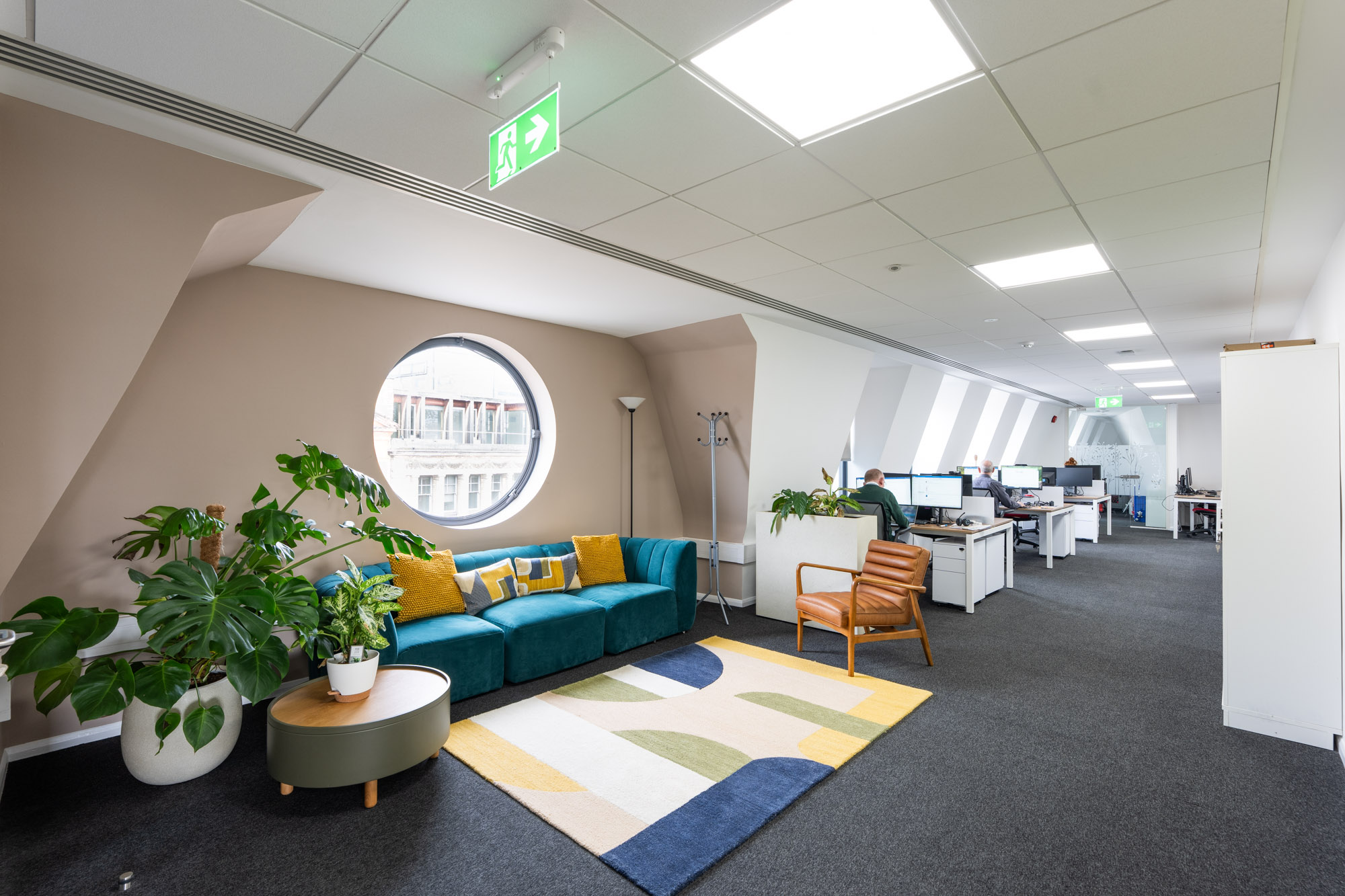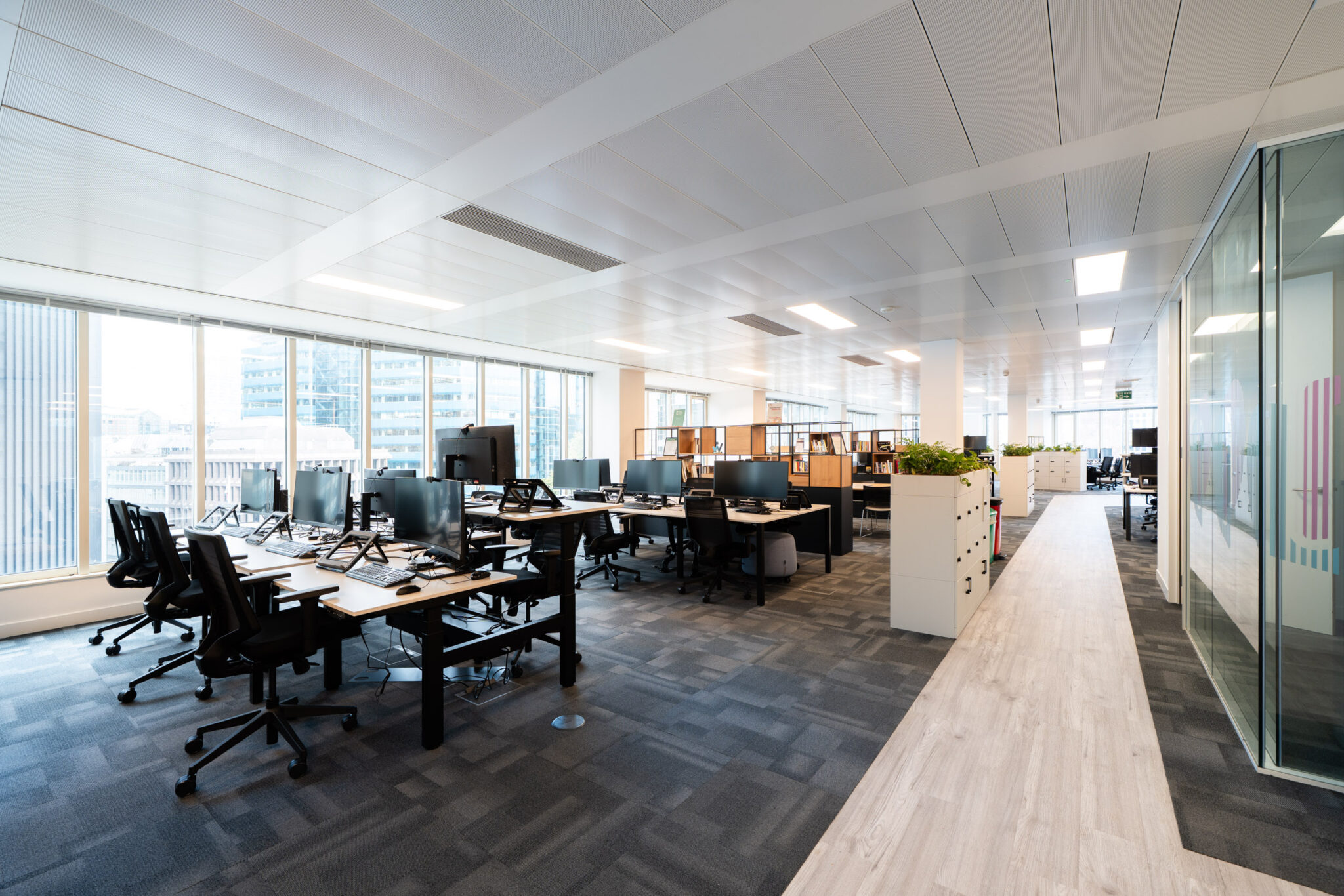
Planning an office fit out means making decisions that affect cost, staff experience, productivity, compliance and future flexibility.
It involves understanding how much space is really needed, what the project should include, how long it will take, what risks to avoid and how to keep disruption under control.
With just shy of 50 years of experience behind us, we’ve put together this guide to answer the most common office fit out questions businesses ask before committing to a new workplace project.
What is an office fit out?
An office fit out is the process of making an office space ready for occupation and day-to-day use.
This can mean turning an empty or partly finished commercial unit into a fully working office, or adapting an existing workplace so it better supports the people and business using it.
A fit out can include space planning, interior design, building works, mechanical and electrical services, lighting, flooring, decoration, meeting rooms, kitchens, washrooms, furniture, storage, signage and technology coordination.
The term is often used alongside office refurbishment, but they are not always the same thing. A fit out usually relates to preparing a space for occupation, particularly during a move or lease event. An office refurbishment usually means improving or reconfiguring a workplace that is already occupied.
What is included in an office fit out?
A typical office fit out includes the design, specification, construction and handover of a workplace. The exact scope depends on the condition of the building, the lease agreement, the organisation’s needs and the available budget.
All office fit outs include some, if not all, of the following:
- Workplace consultancy and briefing
- Space planning and test-fit layouts
- Interior design and finishes
- Cost planning and specification
- Partitioning, meeting rooms and collaboration areas
- Flooring, ceilings and decoration
- Mechanical, electrical and plumbing works
- Lighting design and installation
- Heating, cooling and ventilation coordination
- Fire safety, access control and compliance works
- Kitchen, tea point and breakout areas
- Furniture, workstations, storage and seating
- Acoustic treatments
- IT, AV and data coordination
- Branding, graphics and signage
- Building control, landlord approvals and CDM coordination
- Snagging, handover and aftercare
Not every item will apply to every project. For example, a Cat B fit out (more on this below) of a new office may focus heavily on meeting rooms, furniture, finishes and technology. A refurbishment of an occupied office may need more phasing, furniture moves and relatively lighter decoration.
What is the difference between Cat A, Cat A+ and Cat B fit out?
In office fit out, you will likely come across the terms Cat A, Cat A+ and Cat B. “Cat” is simply short for category.
Cat A fit out describes the basic landlord-provided finish of an office. It may include raised floors, suspended ceilings, basic lighting, toilets, fire systems and mechanical services, but it is not ready for an occupier to move in and work.
Cat A+ fit out is a more finished version of Cat A and is ready for an occupier to move in. Provided by the landlord, It often includes generic furniture, tea points, meeting rooms and finishes, allowing the space to be occupied quickly – ideal for occupiers who want to sign the lease and move in straight away.
Cat B fit out is the occupier’s own fit out. This is where the office is tailored to the organisation’s people, brand, working patterns, storage needs, technology, culture and operational requirements.
For most businesses asking about office fit out, the category they’re referring to is a Cat B fit out.
How do you plan an office fit out?
The best way to plan an office fit out is to start with business needs rather than design ideas.
Before choosing finishes, furniture or layouts, your project team should understand what the organisation is trying to achieve. That might include reducing property costs, supporting hybrid working, improving collaboration, consolidating teams, attracting staff back to the office, upgrading client areas or making better use of existing space.
A practical office fit out plan should include:
- Project objectives – Define why the project is happening and what success looks like.
- Workplace brief – Identify team sizes, work settings, meeting needs, storage, privacy, technology and future growth.
- Building review – Understand the condition of the space, services capacity, landlord constraints and any compliance issues.
- Space planning – Test how many people, desks, rooms and shared settings the office can realistically support.
- Budget planning – Build a realistic cost plan with allowances for construction, furniture, professional fees, technology, statutory approvals, contingencies and VAT where applicable.
- Programme planning – Map out design, approvals, procurement, construction, move-in and handover.
- Procurement route – Decide whether to use a design and build partner, traditional consultant-led route or a hybrid approach.
- Communication plan – Keep staff, landlords, building managers and internal decision-makers aligned.
Good planning reduces late changes. Late changes are one of the most common causes of additional cost and programme pressure.
How much does an office fit out cost in 2026?
Office fit out costs in 2026 vary significantly depending on location, specification, building condition, services requirements, furniture, programme and project complexity.
As a broad UK market benchmark, Cushman & Wakefield’s 2026 UK office fit out cost guide shows all-in costs ranging from £148 to £359 per sq ft in London, £128 to £310 per sq ft in Manchester, £121 to £295 per sq ft in Birmingham and £117 to £284 per sq ft in Glasgow, depending on specification level.
These figures are somewhat useful for early budgeting, but they should not replace a project-specific cost plan. Two offices of the same size can have very different costs if one needs major mechanical and electrical works, upgraded meeting room technology, acoustic treatments, new washrooms or significant landlord compliance works.
To understand the potential costs of your potential fit out and get an accurate budget, it’s always worth reaching out to a respected office fit out company. We do this for free and our clients find it incredibly useful in the early stages to get a gauge on what to expect.
The main factors that affect office fit out cost are:
- Size of the office
- Existing condition of the space
- Quality of finishes and furniture
- Number of meeting rooms and enclosed spaces
- Mechanical and electrical alterations
- Lighting, ventilation and cooling requirements
- Acoustic performance
- IT, AV and security requirements
- Building access, working hours and site restrictions
- Phasing requirements in occupied offices
- Sustainability goals and material choices
- Programme pressure
A sensible budget should also include contingency. Even with a strong brief and survey information, commercial interiors can reveal unknowns once works start, particularly in older or previously altered buildings.
How much office space do I need?
The amount of office space you need depends on headcount, hybrid working patterns, meeting requirements, storage, client-facing space, welfare areas and future growth.
A simple desk count is no longer enough. Many organisations have fewer people in the office every day, but they need more varied settings: focus spaces, collaboration areas, video call rooms, project rooms, quiet rooms and better breakout areas.
The British Council for Offices updated its guidance in 2023 to recommend 10 sq m per person (about 107 sq ft) as an occupancy density design standard for general workspace, with higher-density allowances treated as more exceptional cases.
That does not mean every office should be planned at exactly 10 sq m per person. It is a benchmark, not a finished brief. Some organisations can work efficiently with less space if they have mature hybrid working, shared desks and strong booking systems, like many of our charity clients. Others need more space because of confidential work, client meetings, specialist equipment, storage or wellbeing requirements, as we see in our work with financial services and legal sectors.
A good space plan should answer:
- How many people are employed?
- How many people attend the office on peak days?
- What is the desk-sharing ratio?
- How many meetings happen each day?
- How many calls require privacy?
- Which teams need to sit near each other?
- What storage is essential?
- What growth should be allowed for?
- Which areas can be shared or multi-purpose?
The right office size is not the smallest space you can fit into. It is the amount of space that supports productive work without paying for unnecessary area.

How long does an office fit out take?
A typical office fit out can take anywhere from a few weeks to several months, depending on size, complexity, approvals and procurement.
For a small office with a straightforward scope, construction may take four to six weeks once design and approvals are complete. A medium-sized office may take eight to twelve weeks on site. Larger, more complex or phased projects can take several months.
The full project programme is usually longer than the construction period because it also includes briefing, surveys, design, costing, landlord approval, statutory approvals, procurement, furniture lead times, IT coordination, move planning and handover.
The main factors that influence programme are:
- Project size
- Condition of the existing space
- Lead times for materials and furniture
- Mechanical and electrical complexity
- Number of enclosed rooms
- Landlord approval process
- Building control requirements
- Whether the office is occupied during works
- Out-of-hours or weekend working restrictions
- Decision-making speed
A compressed programme can be possible, but it often increases cost or risk. More labour may be needed, more work may need to happen out of hours and there is less tolerance for late design changes.
What is the office fit out process?
The office fit out process usually follows a sequence from briefing through to handover.
Although every project is different, a typical process includes:
1. Briefing and discovery
This stage defines the business objectives, staff needs, budget, programme and project constraints. It will always include some, if not all, of the following: stakeholder interviews, workplace surveys, building information review and site visits.
2. Space planning
Our design team tests layouts to see how the space can support desks, rooms, collaboration areas, storage, welfare spaces and circulation. This is where many important commercial decisions are made.
3. Concept design
The look, feel and workplace experience are developed. This will include mood boards, finishes, furniture direction, meeting room strategy and initial visualisations.
4. Cost planning
The design is priced and tested against budget. A good cost plan should be transparent (we like to call it a “shopping list”) with clear assumptions and exclusions.
5. Technical design and approvals
Detailed drawings, specifications and construction information are prepared. We organise all landlord approvals, building control matters and CDM (Construction Design and Management Regulations) requirements.
6. Procurement
Materials, furniture and specialist packages are ordered and we organise our site teams as per our step-by-step programme. Early procurement is important where there are long lead items.
7. Construction and fit out works
Our site team delivers the works. In occupied offices, this may involve phasing, temporary decants and weekend works if the programme requires it.
8. Snagging and handover
The completed office is inspected, defects are recorded and resolved, and handover information is provided. This will include operation and maintenance information, warranties, certificates and user guidance.
9. Aftercare
Any good fit out partner will remain involved after move-in to resolve any snags, fine-tune settings and support you once the office is in use. As we directly employ our own labour, it’s easy for us to get our team over to you at a moment’s notice to be on-hand to support.
What are the most common office fit out mistakes?
The most common office fit out mistakes happen before construction starts.
A weak brief, unrealistic budget or rushed decision-making process can create problems that become expensive later. Many issues are actually caused by unclear scope, late approvals, incomplete surveys or assumptions that were never tested.
Common mistakes include:
- Choosing a space before testing whether it works operationally
- Underestimating mechanical, electrical and technology costs
- Focusing on desk numbers rather than working patterns
- Forgetting storage, print, welfare and back-of-house needs
- Not allowing enough time for landlord approval
- Treating furniture as an afterthought
- Ignoring acoustics until staff complain
- Making late design changes during construction
- Not planning for future growth or team changes
- Choosing the cheapest quote without checking what is excluded
- Failing to communicate with staff during the project
- Overlooking CDM, building control or compliance duties
Under the Construction (Design and Management) Regulations 2015, commercial clients have duties to make suitable arrangements for managing a project, including allocating enough time and resources. The HSE also sets out dutyholder responsibilities under CDM, including client, designer, principal designer, contractor and principal contractor duties.
For business leaders, this means an office fit out is a true construction project with legal, operational and commercial responsibilities. Whilst this may sound intimidating, we’ve delivered over 1,000 projects since 1977 so it’s second nature to us. We take pride in making the whole fit out process and simple, easy and even enjoyable.

How do you choose an office fit out company?
Choose an office fit out company by looking at relevant experience, project delivery capability, cost transparency, design quality and how well they understand your business needs.
The best partner is not always the company with the most impressive visuals. A workplace still has to be buildable, affordable, compliant and manageable during delivery.
Before appointing an office fit out company, ask:
- Have they delivered projects of a similar size and type?
- Do they understand your sector and working patterns?
- Can they explain the cost plan clearly?
- What is included and excluded from their proposal?
- Who will manage the project day to day?
- How do they control quality on site?
- How do they manage live or occupied office environments?
- What is their approach to programme risk?
- How do they coordinate furniture, IT, AV and services?
- Can they support landlord approvals and compliance?
- What happens after handover?
It is also worth understanding whether the company relies entirely on subcontractors or directly employs its own trades. We directly employ our own tradesmen, which gives greater control over resource allocation, workmanship, communication and programme delivery. That can be particularly valuable on occupied refurbishments, phased works and projects where quality and responsiveness matter.
How can I ensure a sustainable office fit out?
A sustainable office fit out starts with reducing waste, reusing what already exists and making responsible specification decisions.
Sustainability should not be limited to recycled finishes or energy-efficient lighting. It should consider the whole project: what is stripped out, what is retained, what is reused, what is bought new, how long materials will last and how the office will perform in use.
UKGBC explains the distinction between operational carbon, which comes from running a building, and embodied carbon, which is associated with materials, construction and the building lifecycle. For office fit out projects, that means both energy performance and material choices matter.
Practical ways to improve sustainability include:
- Reusing existing furniture where it is suitable
- Retaining partitions, ceilings or flooring where possible
- Choosing durable materials with lower environmental impact
- Avoiding unnecessary strip-out
- Designing flexible spaces that can adapt over time
- Selecting efficient lighting and controls
- Improving zoning of heating, cooling and ventilation
- Considering refurbished or remanufactured furniture
- Reducing waste during construction
- Specifying products with credible environmental information
- Designing for future disassembly and reuse
UKGBC has also published guidance on embodied carbon reporting, particularly for Scope 3 emissions, which is increasingly relevant for organisations tracking supply chain and fit out-related carbon impacts.
A sustainable fit out is often a more intelligent fit out. Reuse can reduce waste and sometimes cost, but it needs proper assessment. Not every existing item should be retained. The key is to make informed decisions rather than defaulting to full replacement.
Can an office fit out be carried out while staff remain in the building?
Yes, an office fit out can be delivered in an occupied office, but it requires careful planning.
Occupied refurbishments need more coordination than empty-space fit outs. The project team must consider noise, dust, access, safety, temporary moves, welfare, data connections, business-critical teams and communication.
Common approaches include phased works, weekend working, evening shifts, temporary decant areas and isolating sections of the office at different times.
The main priority is to protect business continuity. Staff should know what is happening, when disruption will occur and how it will affect them. Sensitive activities, such as client meetings, confidential work or laboratory operations, may need special planning.
We have experience delivering projects in live and occupied environments, where the success of the project depends as much on communication and sequencing as it does on the finished design.

Is an office fit out worth the investment?
An office fit out is only worth the investment when it supports clear business outcomes.
Those outcomes may include better space efficiency, lower property costs, improved recruitment and retention, stronger client experience, better collaboration, more private meeting space, improved wellbeing, greater flexibility or a more professional working environment.
The risk comes from treating fit out as a cosmetic exercise. New finishes alone will not solve poor space planning, weak acoustics, lack of meeting rooms or inefficient storage.
A good office fit out should help answer commercial questions:
- Are we paying for more space than we need?
- Is the office supporting hybrid working properly?
- Are staff using the workplace as intended?
- Do we have enough private and collaborative space?
- Is our office helping or harming recruitment?
- Can the space adapt as the organisation changes?
- Are we meeting our compliance and sustainability responsibilities?
The best results only come when linking design decisions to measurable operational needs.
What should be included in an office fit out brief?
An office fit out brief should explain what your organisation needs the workplace to do.
It should include headcount, growth plans, working patterns, meeting needs, technology requirements, storage, accessibility, brand, wellbeing priorities, budget, programme and any lease or landlord constraints.
A strong brief should also identify what is not working in the current office. For example, a business may have enough desks but too few meeting rooms. Another may have attractive breakout space but poor acoustic privacy. A charity may need to balance cost control with a welcoming environment for staff, volunteers, trustees and visitors.
The brief should be practical, not just aspirational. It gives the design and delivery team a clear basis for decisions.
How early should you involve an office fit out company?
The earlier, the better. Definitely before signing a lease or committing to a major refurbishment budget.
Early input can help test whether a building is suitable, whether the services are adequate, how much the fit out may cost and whether the programme is realistic. This is especially important if your organisation is choosing between staying, refurbishing, relocating or taking serviced space.
A fit out partner can also identify issues that may not be obvious during a viewing, such as cooling capacity, floorbox positions, access restrictions, riser space, landlord requirements or the cost of adapting existing services.
Early advice is usually less expensive (and a lot less stressful) than correcting the wrong decision later.
How Constructive Space can help
We support organisations planning office fit out, refurbishment, relocation, minor works and workplace improvement projects across the UK.
Established in 1977, we have delivered more than 1,000 office design and fit out projects for charities, legal firms, professional services, corporate occupiers, life sciences businesses and landlords.
The value lies in combining practical design advice with real delivery experience. That includes space planning, cost control, buildability, phasing, sustainability, furniture reuse, compliance and managing work in occupied offices.
If your organisation is going to be reviewing its workplace, the right starting point is a clear conversation about needs, constraints and options. Complete the form below, or email us at info@constructivespace.com to start the conversation.